Just Released: The 2026 State of Cognition Report. Bridge your organization's AI adoption gap.


Key Takeaways
- Speed is the New Currency: The primary challenge in 2026 is "Organizational Lag", which happens when a company moves more slowly than the market.
- Strategy Expired Quickly: Annual planning is now a risk because the foundational assumptions of a business plan often change within months.
- Behavior is the Bottleneck: Most delays are caused by human friction, which can be measured and fixed through Behavioral Intelligence.
In 2026, the biggest struggle for leaders is staying in sync with a world that never stops moving. It is no longer about having the best data or the smartest people. The real problem is the gap between how fast the world changes and how slowly a company makes decisions. We call this "Organizational Lag." It is a dangerous state where a team continues to work hard on a plan that is already out of date.
As we move deeper into a world of autonomous AI and shifting global trade, the old way of doing business has broken. Making decisions by committee or waiting for annual reviews causes friction. This friction slows down execution and bleeds revenue. For a CEO or an L&D Director, the goal is now clear: upgrade how people work together. We must move from static planning to a state of constant, active adaptation.

Why the World is Moving Faster
To fix the lag in our companies, we first need to understand the forces pushing us. In 2026, three major shifts are happening at the same time. These forces are connected, and they leave very little room for executive error.
1. Global Shifts and Resilience
Trade is no longer just about finding the lowest cost. It is about being ready for anything. Global risks are now a permanent part of doing business. The World Economic Forum reports that three out of four leaders now prioritize resilience as their primary growth goal. Leaders must process global news as a signal to change their strategy immediately. If a team is slow to align around these shocks, the result is a blocked supply chain and lost capital.
2. The Rise of Agentic AI
We have moved past AI that simply writes emails. We are now in the era of Agentic AI. These are systems that can perform complex tasks independently, from managing logistics to handling procurement. Deloitte estimated that 85% of companies are now building their own AI agents. Gartner says by 2028, AI agents will handle $15 trillion in business spending.
While this technology is fast, the human side is lagging. Many leaders are struggling to redesign their workflows to keep up. McKinsey shows that while 92% of companies are spending more on AI, only 1% feel their teams are actually ready to use it effectively.
3. Rapid Capital Shifts
Money is moving faster than ever into new technologies. This forces leadership teams to constantly look at their projects and ask: "Is this still worth it?" Leaders must be ready to stop old projects and move resources to new opportunities instantly. This requires a level of team alignment that most organizations currently lack.
[Test] Are your leaders sensing the market or just following an old plan?
The AFERR Model helps your team adapt to change by using the way the human brain actually works. We provide the framework your people need to turn a fast-moving world into a clear strategic advantage. Move past rigid planning and start building a team that is always ready for what is next.
The Shrinking Life of Strategy
For a long time, companies treated strategy as a yearly event. Leaders would meet, make a plan, and follow it for twelve months. This worked when the world was stable. In 2026, that way of thinking is a liability.
The "half-life" of a strategy is the time it takes for a plan to become obsolete. Today, that time is shrinking. When a trade policy changes overnight, or a competitor launches a new AI tool, your three-year plan can become useless in weeks. The danger is "Strategic Drift." This happens when your team is still executing a plan designed for a reality that no longer exists.
The data is clear: only 12.5% of strategic projects are ever finished successfully. Most fail because the leadership team is not in sync. Strategy must become a living, breathing capability within the company.
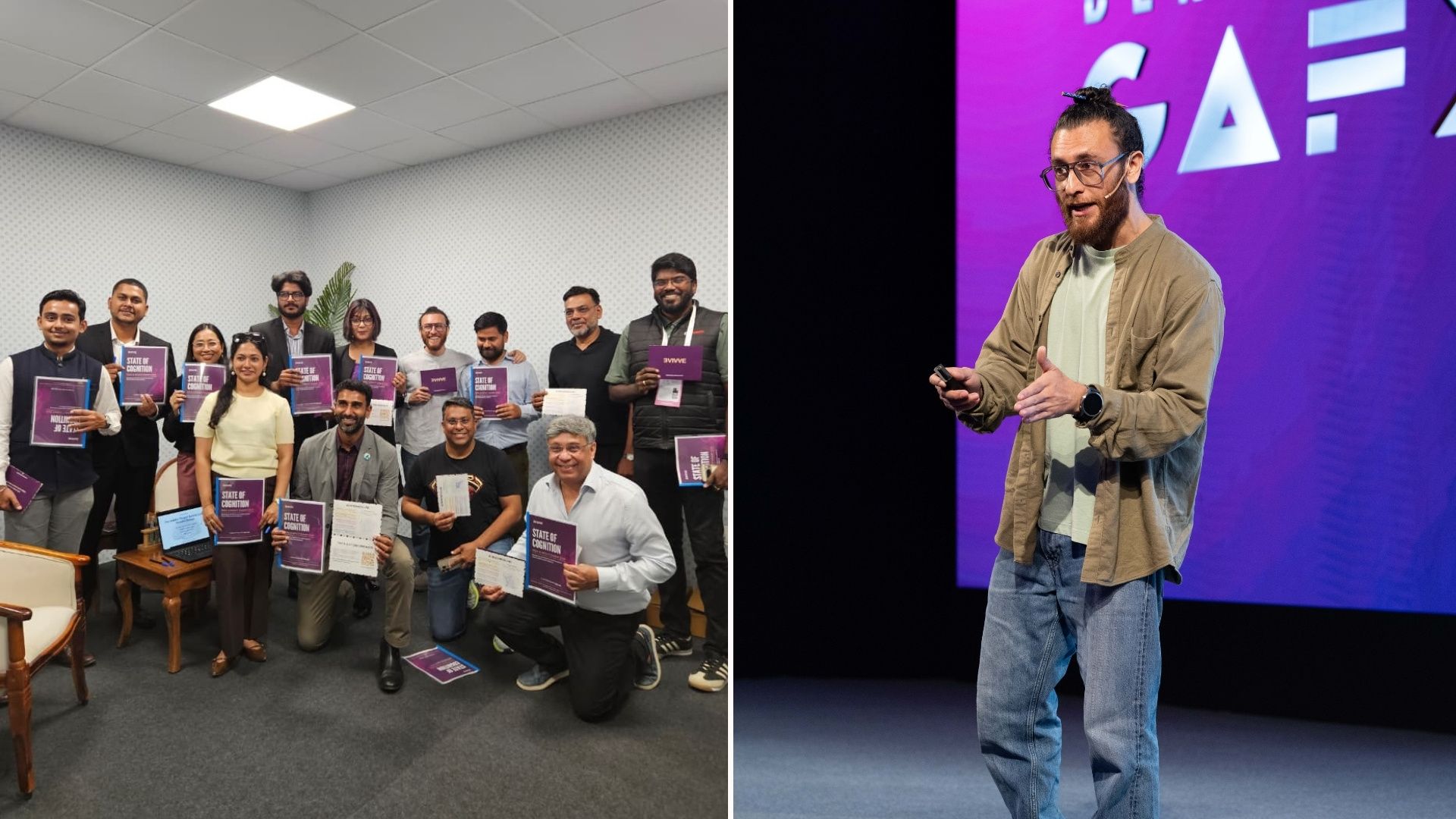
Mohsin Memon at India AI Impact Summit and Bengaluru GAFX sharing insights on how leadership behavioral diagnostics solve the alignment gap in modern organizations.
The Cost of Being Slow: The Slowness Tax
Most large companies are slowed down by internal friction. This is not a lack of talent. It is a failure of how leaders process information and make choices together. This creates a "Slowness Tax."
Research shows that companies lose up to 5% of their annual revenue because of slow decision-making. For a large enterprise, this means hundreds of millions of dollars are lost to internal bureaucracy.
Symptom of Friction | Why it Happens | Organizational Impact |
Analysis Paralysis | Fear of making a mistake in a fast market. | Lost market opportunities and missed windows. |
Consensus Seeking | Prioritizing "getting along" over moving fast. | Extended timelines and bloated project costs. |
Interpretive Drift | Different leaders have different views of the goal. | Wasted labor hours and internal conflict. |
Resource Rigidity | Refusing to stop old projects to fund new ones. | Strategic drift and failure to scale AI. |
The Human Brain and the AI Gap
AI is beyond a tech challenge. It is a human challenge. When people feel that their jobs or status are threatened by new technology, their brains go into "threat mode." This literally stops the part of the brain used for strategy and problem-solving.
This creates "Learning Debt." This is the gap between the new tools we buy and our team’s ability to actually use them. To fix this, leaders must move their teams from fear to "Superagency." This means humans act as the conductors of AI agents, using their judgment to drive the business forward.
The Five Dimensions of Adaptiveness
To beat the Slowness Tax, we must change how we develop leaders. Traditional reviews only show what people think they do. We need to see what they actually do when the pressure is on. This requires focusing on five areas:
- Signal Detection: How fast can the team see a change in the market?
- Emotional Framing: Does the team see change as a threat or an opportunity?
- Resource Reallocation: How quickly can the team move budget and people to new goals?
- Decision Alignment: Are all leaders moving in the same direction?
- Execution Responsiveness: How fast does a boardroom decision reach the frontline?
Solving the Crisis with Diagnostic Simulations
How do you measure these five areas? In 2026, the answer is Live Simulations. These are behavioral labs where leadership teams face realistic pressure in a safe environment. Because the stakes feel real, the "corporate mask" falls off. The true bottlenecks become visible.
Evivve uses these labs to create Dynamic Reports. These reports give you hard data on how your team actually works:
- Personal Dynamic Report (PDR): Shows an individual leader’s risk style and stress response.
- Group Dynamic Report (GDR): Maps where the team is in sync and where they are stuck.
- Organizational Diagnostic Report (ODR): Identifies the big-picture blocks in your entire organization.
By using these reports, Evivve helps you connect this data with your organizational priorities in real-time. Thus, you train your leaders to be ready for any challenge.
Conclusion: The Strategic Mandate for 2026
The companies that win in 2026 will not be the ones with the most AI or the most data. They will be the ones with the fastest human decision systems. High-trust collaboration and synchronized execution are the only ways to stay ahead of a shrinking strategy cycle.
It is time to stop wondering why your initiatives are stalling. It is time to diagnose the behavior of your leadership. The world is moving fast. Ensure your team is moving faster.




Creating authentic learning experiences with the power of games and neuroscience.
Play Evivve



© 2026 Evivve. All rights reserved
Leave A Reply
Your email address will not be published. Required fields are marked *